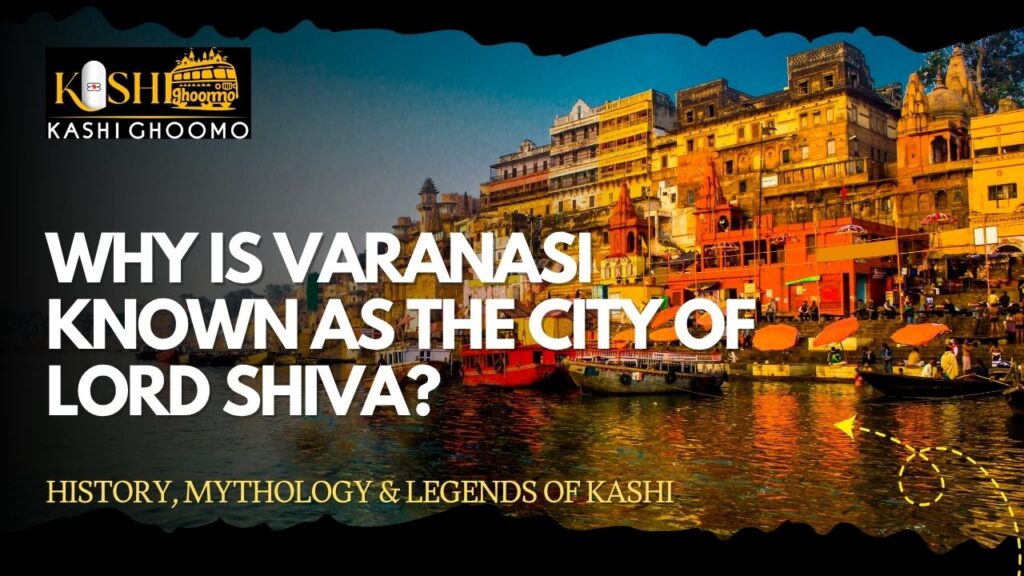
Why is Varanasi Known as the City of Lord Shiva? History, Mythology & Legends of Kashi

Why is Varanasi Known as the City of Lord Shiva?

If you have ever planned a trip to India, you must have heard this line: Varanasi is the city of Lord Shiva. But why? Why not any other Indian city? In this blog, we answer the question why is Varanasi known as the city of Lord Shiva in the simplest way possible — through the stories, history, and living traditions that still shape this ancient city today.

Why is Varanasi Known as the City of Lord Shiva?

Varanasi is known as the city of Lord Shiva because Hindus believe it is Shiva’s own home on earth — the place he chose to live with his wife, Goddess Parvati, and never leave. According to popular belief, Varanasi is the abode of Lord Shiva and Parvati, and the true origins of the city are unknown. The Ganga that flows through Varanasi is also connected to Shiva. It is said that the river Ganga has its origin in the matted locks of Lord Shiva, and in Varanasi it widens into the mighty river we see today.

Adding to this, Varanasi is home to the Kashi Vishwanath Temple, one of the twelve sacred Jyotirlingas of Shiva in India. As per the temple’s official records on the Kashi Official Web Portal, Government of Uttar Pradesh, the Jyotirlinga enshrined here is worshipped as Vishweshwara or Vishwanath, meaning “Lord of the Universe,” and a mere glimpse of it is believed to bring spiritual liberation to devotees. This single belief — that Shiva himself resides here and grants moksha (liberation) to anyone who dies within the city — is the real answer to why is Varanasi known as the city of Lord Shiva.

If you want to feel this connection yourself, the best way is to visit the Kashi Vishwanath Temple and witness the Ganga Aarti in person on a peaceful boat ride.

What is the History of the City of Varanasi?

Varanasi’s history goes back thousands of years, and no one knows its exact starting point. As per the Government of Uttar Pradesh’s district portal, Varanasi, also called Benaras or Kashi, is one of the oldest living cities in the world, and its role in Hindu mythology is described as almost unmatched. The Ministry of Tourism’s official Incredible India portal adds that Varanasi stands along the sacred Ganga with roots tracing back more than 3,500 years, and Hindu mythology holds it to be the very place where the world was created.

Over the centuries, Varanasi has seen invasions, destruction, and rebuilding — but it always rose again. The current form of the Kashi Vishwanath Temple, for example, was rebuilt in 1780 after being destroyed several times. As per government tourism records, the temple underwent restoration in 1780 under the Maratha queen Ahilyabai Holkar, centuries after it had been plundered. This is one reason the city is often called “eternal” — no matter what happens, Kashi survives.

You can read the complete official account of the district’s past on the Government of Uttar Pradesh’s Varanasi district portal.

What is the Old Name of Varanasi?

Many people search for the old name of Varanasi, and there isn’t just one — there are actually three names used through history:

  • Kashi — meaning “the city of light,” referring to the spiritual light of Shiva
  • Banaras (or Benaras) — the popular name used during the medieval and British periods
  • Varanasi — the modern official name, believed to come from two rivers, Varuna and Assi, that meet the Ganga here

All three names are still used today — locals often say “Kashi” for the spiritual identity of the city, “Banaras” for its culture and food, and “Varanasi” as the formal name on maps and documents.

What is the Connection Between Shiva and Varanasi?

This is really the heart of the entire story. The connection between Shiva and Varanasi is not just about one temple — it’s about the belief that Shiva personally lives in the city and never abandons it, even during destruction or disaster. This is why Kashi is called “Avimukta Kshetra” — the place Shiva never forsakes.

Hindus believe that anyone who dies in Kashi receives “Kashi Labh Muktih” — instant liberation from the cycle of birth and death — because Lord Shiva himself whispers the Taraka Mantra (a sacred mantra of liberation) into the ear of the dying soul. This belief is what makes Manikarnika Ghat, the city’s main cremation ground, spiritually significant rather than something to fear.

This unbroken connection between Shiva and Varanasi is also why the city hosts thousands of small and large Shiva temples — Kashi Vishwanath, Kaal Bhairav, Tarakeshwar, and many more — spread across every lane of the old city.

Varanasi Shiva Story — The Legend Behind Manikarnika Ghat

One of the most well-known Varanasi Shiva stories is connected to Manikarnika Ghat. As per the Ministry of Tourism’s official records, Lord Vishnu once created a sacred pool near this ghat for Shiva and Parvati to bathe in, and during that bath, an earring (“Mani”) belonging to Parvati fell into the pool. To recover it, Lord Shiva himself dug a well at the spot, filling it with his sacred sweat and blessing it with divine sanctity — this is how Manikarnika Ghat got its name, and why it is considered one of the holiest cremation sites in Hindu tradition.

Stories like this are found at almost every ghat in Varanasi — each one tied back to Shiva, Parvati, or another deity. This is part of what makes a walk along the ghats feel like walking through a living scripture. If you’d like a guided experience of these stories in person, our things to do in Varanasi guide covers the best spots to explore them.

Who is the Half Male, Half Female God Worshipped in Kashi?

The half-male, half-female form worshipped in Kashi and across Shiva temples in India is called Ardhanarishvara — literally “the Lord who is half woman.” This form combines Shiva (the right half) and Parvati (the left half) into a single body. It represents the belief that the masculine and feminine energies of the universe are not separate, but one complete whole. In Kashi, where Shiva and Shakti (the goddess energy of Parvati) are worshipped together everywhere — from the Kaal Bhairav Temple to the Annapurna Temple — the idea of Ardhanarishvara is a perfect symbol of the city’s balance between the two.

You can learn more about Kashi’s other important Shiva shrines, like Kaal Bhairav Mandir, where this Shiva-Shakti balance is worshipped daily.

Why is Kashi Gangajal Not Allowed to Be Taken Home?

This is a popular belief you’ll often hear from locals and priests in Varanasi: Gangajal (Ganga water) collected from Kashi is traditionally not carried back home, unlike Gangajal from Haridwar or Gangotri. The common explanation given by pandits is that Kashi is considered “Moksha Nagri” — the city of liberation — where countless souls complete their final journey through cremation and immersion of ashes at the ghats. Because of this, many believe the water here carries the energy of that final release, and taking it away is thought to disturb that sacred process.

This is a matter of local faith and tradition rather than a formal rule, and beliefs about it vary from priest to priest. What travellers can still bring home from Kashi, according to popular practice, are other sacred items like rudraksha beads or small Shiva lingams as blessed souvenirs of their pilgrimage.

Why is Varanasi So Very Special? What Makes it Different?

Many People often ask, “what is special about Varanasi,” and the honest answer is that no other city in India combines spirituality, history, food, and daily life quite like Kashi does. Here’s what makes it special:

  • It’s one of the oldest living cities on earth — older than most recorded history
  • It’s home to a Jyotirlinga — one of only twelve in the country
  • Death is treated differently here — as a passage to liberation, not just an ending
  • It has an unbroken tradition of learning — home to Banaras Hindu University and centuries of Sanskrit scholarship
  • The Ganga Aarti — a nightly ritual so grand it draws thousands of visitors from around the world
  • Every lane has a legend — temples, ghats, and streets are all tied to stories of Shiva and Parvati

If you want to witness this for yourself, our morning Ganga Aarti and evening Ganga Aarti experiences are the easiest way to feel the city’s spiritual pulse in a single visit.

Varanasi is Known as the City of — Quick Facts

If you need a quick summary (perfect for students or first-time readers), here it is:

  1. Varanasi is known as the City of Lord Shiva
  2. It is also called the City of Temples
  3. It is known as the City of Light (Kashi)
  4. It is called the City of Liberation (Moksha Nagri)
  5. It is one of the oldest living cities in the world
  6. It is home to the Kashi Vishwanath Jyotirlinga
  7. The Ganga River flows through the heart of the city
  8. It is a major hub of Hindu learning and Sanskrit tradition
  9. Sarnath, where Buddha gave his first sermon, is just a short drive away
  10. It hosts the world-famous nightly Ganga Aarti at Dashashwamedh Ghat

Varanasi is Famous for Which God?

Varanasi is most famous for Lord Shiva, worshipped here as Kashi Vishwanath. But the city is also home to many other deities connected to Shiva’s family and mythology — Goddess Parvati (as Annapurna and Vishalakshi), Lord Bhairav (Shiva’s fierce guardian form at Kaal Bhairav Temple), and Lord Hanuman at Sankat Mochan Temple. Still, when people ask which god Varanasi is famous for, the answer almost always comes back to Shiva — the god this entire city is built around, both in myth and in daily worship.

Final Thoughts

So, why is Varanasi known as the city of Lord Shiva? Because for thousands of years, Hindus have believed this is where Shiva lives, where he never leaves, and where death itself becomes a doorway to liberation rather than an end. Every ghat, every temple, and every lane in this ancient city carries a piece of that belief.

If reading about it has made you want to see it for yourself, Kashi Ghoomo can help you experience it the right way — from sunrise boat rides to Kashi Vishwanath darshan. Check out our Varanasi tour packages or explore more travel guides on our blog.

Ready to Walk Through the Legend Yourself?

Reading about Kashi is one thing — standing on its ghats as the Ganga Aarti lights up the river is another. Let Kashi Ghoomo help you experience Lord Shiva’s eternal city the way it’s meant to be seen:

📞 Call/WhatsApp us: 9140800515
📧 Email: kashighoomo@gmail.com
🌐 Website: www.kashighoomo.com

The city Shiva never leaves is waiting for you. Reach out today and let’s plan your Varanasi journey.

Frequently Asked Questions

 Varanasi is known as the city of Lord Shiva because Hindus believe it is his permanent home on earth, marked by the Kashi Vishwanath Jyotirlinga and the belief that he never abandons the city, even during destruction.

Varanasi is one of the oldest continuously inhabited cities in the world, with roots tracing back over 3,500 years. It has been ruled by Hindu kings, Mughal emperors, and Maratha rulers, and the current Kashi Vishwanath Temple was rebuilt in 1780 by Ahilyabai Holkar.

Yes. As per Incredible India, Varanasi’s roots go back more than 3,500 years, which is generally regarded as older than Rome, making it one of the oldest continuously inhabited cities on earth.

These are three names for the same city. Kashi refers to its spiritual identity as the “city of light,” Banaras (or Benares) is the name popularly used for its culture, food, and daily life, and Varanasi is the modern official name used on maps and documents.

Varanasi is known as the City of Lord Shiva, the City of Temples, the City of Light (Kashi), and the City of Liberation (Moksha Nagri).


Call Now Button